All-electric, all measured.
No natural gas. No ductwork. Six inverter-driven heat pumps, three outdoor compressors, and an envelope tight enough to hold sixty-five degrees in a Midwestern winter on partial load.
A year on the meter — an example.
Monthly kilowatt-hours from AES Ohio's actual meter reads — one owner-occupied year, drawn straight from the utility bill. The shape is what an all-electric house should look like: a clear winter heating peak, a deep summer trough, and an annual average comfortably under one thousand kilowatt-hours per month.
Thirteen monthly reads shown, September 2023 through September 2024. Source: AES Ohio account billing history; the twelve-month sum for September 2023 – August 2024 (8,542 kWh) is what AES prints as the "Historical average usage: 711.83 kWh" reference on every monthly bill. The peak month, February 2024, falls within the home's qualified electric-heating winter rate. The chart shows one owner-occupied year of selective zone use as an example.
Natural gas was removed for health, environmental, and operating-cost reasons. With the upgraded service and a tight envelope, the heat pumps run efficiently — and the gas connection (and its monthly fixed charge) simply isn't there.
First efficiency, then production.
Most "green" retrofits start by adding solar panels to the same leaky envelope, the same gas furnace, the same century-old wiring. The result is a renewable supply tax-credited onto an unchanged demand — and a roof full of panels working overtime to make up for what the house keeps losing.
We took the opposite path. Reduce the demand first; produce later — or never, if it's not needed.
| Phase | Done at 346 Corona | Result |
|---|---|---|
| 1 · Reduce | Tight envelope · two insulation layers · radiant barrier · new Energy Star windows · all-new plumbing and wiring | Heating and cooling load cut to a fraction of an inefficient comparable. Owner-occupied year measured under 1,000 kWh/mo on average (annual sum 8,542 kWh). |
| 2 · Electrify | All gas removed · multi-zone heat-pump HVAC · heat-pump water heater · induction-ready electric kitchen | Every joule the house consumes can come from the grid — and from the grid's cleaner future. |
| 3 · Produce (optional, future) | Roof and 200 A service ready for a small PV array — sized against the already-reduced load. | An owner who later chooses to add panels can target full energy independence with a much smaller, cheaper system than the original house would have required. |
Why the order matters: cut the load by a third and you cut the size of any future solar array by the same third. Solar is most powerful when it's pointed at a small, predictable demand — not used as a band-aid on a leaky one.
Quieter, cleaner, more deliberate.
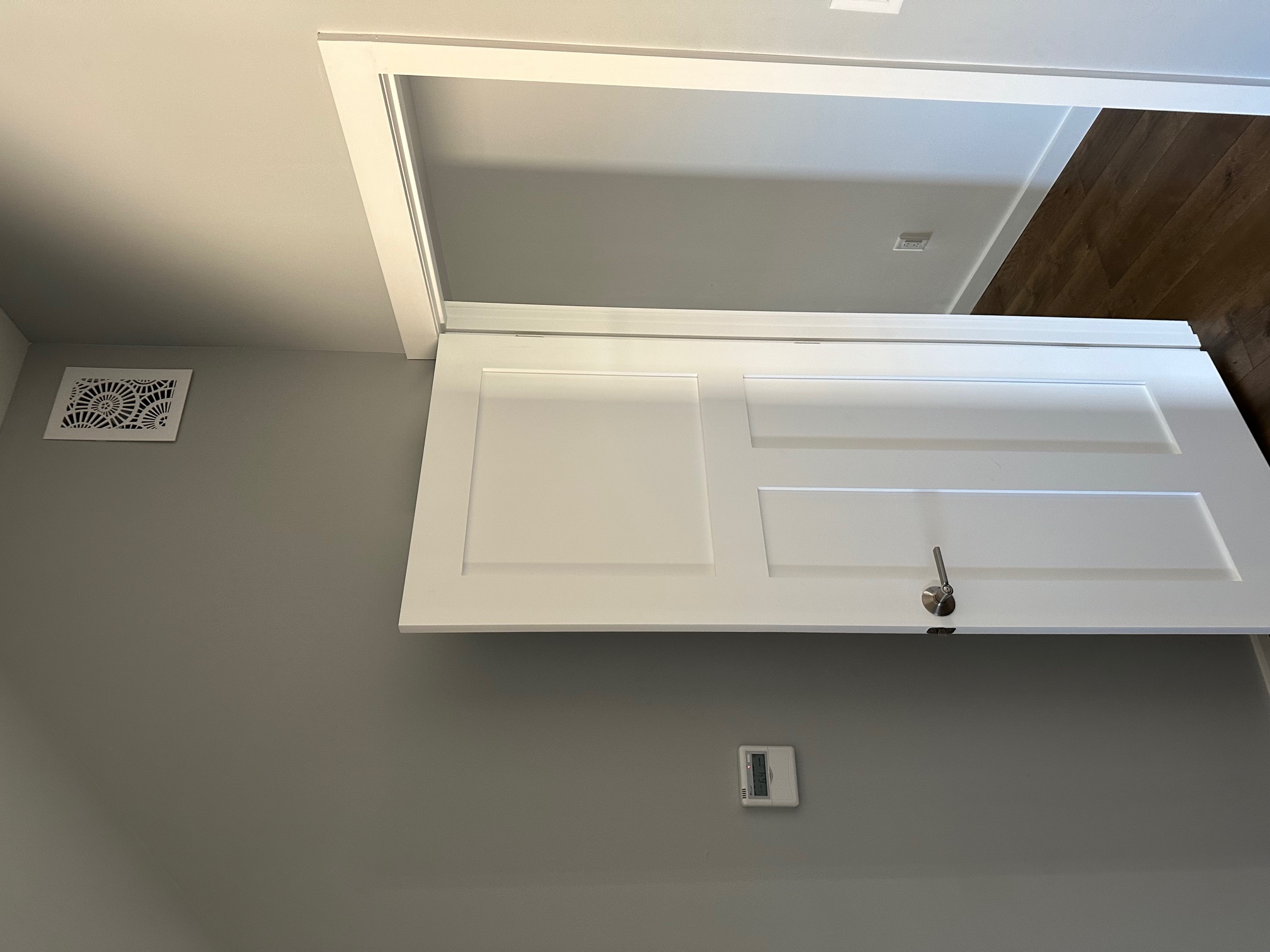
Forced-air systems circulate dust and allergens, lose energy through duct runs, and are loud. The house was rebuilt without them — instead, six zones across the house, some serving a single room and some a related cluster, each controlled when and where it's needed.
The removed ductwork freed the basement: ceiling height now reaches up to seven feet, and the basement is conditioned along with the upper floors. Heat held in the basement keeps the underside of the first-floor structure warm — and the floor itself warm underfoot. A second exterior door to grade leaves the space ready for a finished family room when the next owner wants it.
Different rooms, different settings, different times.
Each of the six zones has its own thermostat, its own schedule, and its own setpoint. Bedrooms can stay cool while the living room runs warm. The kitchen can hold a target only when it's in use. Zones not in use cost nothing to condition.
| Advantage | What it means at 346 Corona |
|---|---|
| Setpoint per zone | Sleep at seventy upstairs while the living room holds seventy-two by day and drops to sixty-eight at night. Each indoor unit has its own thermostat. |
| Schedule per zone | Setbacks during work hours, occupied-zone targets at night — programmed independently for each zone. |
| Unoccupied zones idle | The flex-room zone or the downstairs-bedroom zone can be turned off entirely when not in use, with no impact on comfort elsewhere. |
| Conditioned basement | The basement is conditioned along with the upper floors. Heat retained there keeps the underside of the first-floor structure warm — so the floor reads warm underfoot, without a separate radiant system. |
| No duct losses | Forced-air ducts typically lose 20–30 % of conditioned air through leaks and uninsulated runs (DOE). With no ducts, every joule reaches the room it was meant for. |
| Per-zone dehumidification | Each unit has its own coil and blower, so humidity is managed where it appears — not averaged across the house. |
| Quiet operation | No central air handler cycling on and off. Indoor heads run at nineteen to forty decibels on low. |
| System resilience | Three outdoor compressors. If one ever needs service, the other zones keep working. |
| Cooling efficiency | Senville AURA units rated roughly 19–25 SEER2 across the installed models — well above Ohio's 13.4 SEER2 federal minimum for new central AC, and competitive with upper-tier conventional systems (mid-grade 15–17 SEER2; top-of-line ~24–28 SEER2). |
Sources: U.S. Department of Energy Energy Saver guidance on ductless mini-split heat pumps and on duct losses; ENERGY STAR ductless heating and cooling fact sheet; Senville AURA published SEER2 specifications; current U.S. DOE regional efficiency standards (Northern region, residential split-system AC).
Six zones, three compressors.
| Zone | Capacity | Configuration |
|---|---|---|
| Primary bedroom · 2nd floor | 12,000 BTU | Wall-mounted mini-split |
| Upstairs bedrooms and bathroom | 12,000 BTU | Concealed duct |
| Kitchen | 12,000 BTU | Concealed duct |
| Downstairs bedroom and half bath | 12,000 BTU | Concealed duct |
| Main level · open space | 18,000 BTU | Concealed duct |
| Flex room · downstairs bath | 9,000 BTU | Concealed duct |
All units are inverter-driven cold-climate models from Senville's AURA line. Equivalent units are sold by Carrier and other major manufacturers. The system is on annual maintenance with a local HVAC contractor; the service plan is transferable to the new owner and already paid for the current year.
What it could cost, at today's rates.
| Supplier | Plan | Rate | Modeled monthly * |
|---|---|---|---|
| AES Ohio (default) | Standard service offer | 9.45 ¢ / kWh | ~ $127 |
| AES Ohio (electric heating) | Seasonal · Nov–May | 8.0 ¢ / kWh | ~ $112 |
| Public Power | 12-month fixed | 8.0 ¢ / kWh | ~ $112 |
| Ohio Gas & Electric | Power Lock 12-month | 8.7 ¢ / kWh | ~ $119 |
| Lowest market offer | Various 6–12 mo terms | from ~6.1 ¢ / kWh | ~ $93 |
* Modeled at 1,000 kWh consumption plus AES Ohio's ~$32 delivery. The owner-occupied documented year averaged below this — closer to 700 kWh/mo — which would put each row roughly $20–25 lower. Real-world cost will vary with occupancy and behavior: more zones run, more hours, more people, more bill. This house qualifies for AES Ohio's electric-heating rate (the 8.0 ¢/kWh winter row) because all space heating is electric. Rates observed via the PUCO Apples-to-Apples comparison in May 2026; supplier offers change frequently and can be re-shopped at contract renewal.
Electricity is the steadier bill.
Removing the gas connection isn't only an environmental and health choice — it's an exposure choice. Residential natural-gas prices have risen more, and more abruptly, than residential electricity over the last several years.
| Mechanism | Electricity | Natural gas |
|---|---|---|
| How rates change | State rate cases · multi-year cycles · stepwise adjustments | Monthly or quarterly commodity pass-through |
| Fuel exposure | Diversified mix — gas, nuclear, renewables, coal — fuel shocks diluted | Roughly one hundred percent gas commodity plus delivery |
| Global market exposure | None directly | U.S. Henry Hub linked to global gas via LNG export terminals |
| Recent Ohio specifics | AES Ohio default rates set via PUCO quarterly auctions | Columbia Gas of Ohio's commodity charge nearly doubled for the 2025–26 delivery year |
Sources: U.S. Energy Information Administration retail price data (residential gas $/Mcf, residential electricity ¢/kWh, 2020–2025); Office of the Ohio Consumers' Counsel and PUCO filings on the Columbia Gas Standard Choice Offer for the 2025–26 delivery year. The 2021–22 spike in U.S. gas prices coincided with Russia's invasion of Ukraine and the rapid expansion of U.S. LNG exports to Europe.
A house that holds its temperature, runs on a single utility, and goes carbon-neutral the moment you choose a green supplier.